Peux-tu nous parler de ton parcours ?
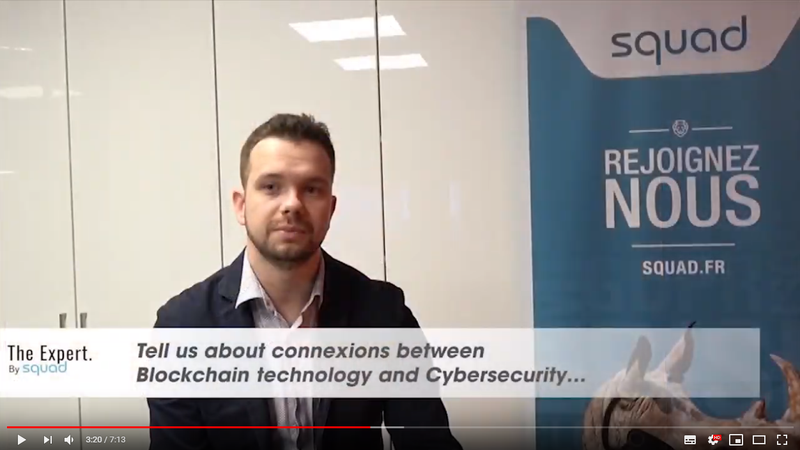
Je m’appelle Nikola Bozic, je suis arrivée en France (depuis la Serbie) en 2014 après mes études d’ingénieur à Belgrade (Serbie). J’ai fait mon master à Central Sup Elec et, depuis les 3 dernières années, je travaille sur mon doctorat, avec une thèse en collaboration entre Squad et le Laboratoire Informatique de Paris 6, dépendant de l’Université de la Sorbonne.
L’opportunité d’avoir collaboré avec Squad durant ces années m’a permis de travailler sur des sujets très challengeant et mes recherches sont orientées principalement vers les systèmes Cloud, la virtualisation et, plus récemment, sur la technologie de la blockchain.
Peux-tu nous expliquer la technologie de la blockchain « pour les nuls » ?
En quelques phrases, on peut dire que la blockchain est un nouveau paradigme, un nouveau système qui permet de centraliser tout type d’informations liées à un processus de création de valeur. Pour faire simple, jusqu’à présent, tout type de transaction étaient orchestrées par une entité centralisée. La blockchain est une technologie qui distribue cette orchestration et rend possible les transactions sans aucun type de chef d’orchestre. C’est un peu l’essence même de la blockchain : un système de transaction et de reporting décentralisé sans gouvernance unilatérale.
Est-ce que la technologie de la blockchain implique que n’importe qui est un contributeur à la donnée ?
C’était en effet, la première motivation de la blockchain lors de sa création et des premiers systèmes qui en ont découlés. Il faut se rappeler que la technologie de la blockchain a déjà 10 ans d’existence et qu’elle a évolué depuis. Aujourd’hui, plusieurs typologies de systèmes coexistent :
- Celui ou n’importe qui peut participer sur le réseau et avoir accès aux datas
- Mais aussi une nouvelle génération de plateformes utilisant la blockchain qui permettent de définir qui va participer sur notre réseau, et qui pourra profiter d’un accès aux datas.
Donc, la technologie de la blockchain ne veut pas nécessairement dire une information publique et partagée par tous : c’est une technologie que l’on peut tout à fait configurer dans un environnement privé ou restreint.
Quel est ce nouveau paradigme qu’implique la technologie de la blockchain ?
La blockchain est en soit un nouveau paradigme qui va radicalement changer le business tel que nous le connaissons dans de nombreux secteurs d’activité (industrie, finance ou même protocoles web…).
Je vais présenter la blockchain plus précisément dans une cession de MixYourTalent Squad et présenter des cas concrets[HL1] derrières la terminologie pure et au-delà du cas emblématique des cryptomonnaies.
Concrètement la technologie de la blockchain s’adapte et s’adopte dans bien des champs d’application. C’est toute l’élégance de cette technologie, tout son intérêt et sa portée potentielle. Cela témoigne de son pouvoir de transformer l’économie, depuis le consulting jusqu’à l’ingénierie.
Aujourd’hui, tous les fournisseurs de Cloud ont intégré la blockchain comme un service à part entière. Cela ouvre de nouvelles opportunités de business, tant pour les sociétés de consulting, en DevOps, pour les techniciens, mais aussi pour le consulting stratégique. En effet, le problème actuel est que la technologie de la blockchain reste aujourd’hui une « Boite noire » assez méconnue. Bien qu’on soit en 2019, quand on parle de recherche et des personnes qui travaillent sur ces domaines, on constate de vraies avancées … mais quand on parle au grand public, il est toujours en 2008, où la blockchain était assimilée au BitCoin.
L’une des plus grandes initiatives encours du point de vue européen est l’éducation du grand public sur ce qu’est la blockchain et comment n’importe qui peut bénéficier de cette nouvelle technologie.
Parle nous du lien entre Blockchain et Cybersécurité…
La blockchain est une technologie qui utilise la combinaison de composant déjà très connus en termes de chiffrement et de cybersécurité. Elle utilise déjà des technologies telles que le hash function ; les systèmes PKI ou les signatures électroniques… Ce n’est pas tant la partie chiffrement de la blockchain qui est nouvelle puisque la blockchain utilise des technologies déjà existantes dans une différentes combinaison adaptées à un nouveau système. Ce qui est nouveau est l’idée même de la centralisation qui implique que le protocole de communication et les contenus s’appuient dessus. Donc, oui, bien sûr, la blockchain est étroitement liée aux systèmes de Cloud et à la cybersécurité, car, quand on entend un nouveau système, on doit en sécuriser le réseau et réfléchir à la possible propagation du système, à la migration d’un système à un autre, … il y a donc un vrai besoin d’experts en cybersécurité et en virtualisation, dans les applications utilisant la technologie de la blockchain.
Pour fonctionner, la technologie de la blockchain impose d’être partagée par de nombreux utilisateurs. C’est une nouvelle vision de la gestion de la data ?
Oui c’est la plus grande innovation de cette technologie et ce qui en fait sa force. La blockchain est vraiment en train de s’orienter vers des communautés OpenSource ce qui est je pense la bonne direction car cela permet à tous les acteurs de participer collégialement. L’idée est de créer un grand réseau intégrant tous les acteurs, une combinaison entre les secteurs public et privé. Donc, oui, le consulting aide dans la gouvernance afin de comprendre comment adapter la blockchain ; il y a un énorme nouveau marché. On estime à 3.000 le nombre de stratup qui gravitent dans l’univers de la blockchain avec une valorisation moyenne à 5 millions d’Euros. Il y a plus d’un millier de business angels sur le sujet… on parle vraiment d’un énorme marché en devenir qui porte des opportunités pour les entreprise High-Tech, les stratups, et le consulting… c’est une vraie combinaison de talents entre les nouvelles technologies, ceux experts des technologies existantes dans le web et le cloud ; une combinaison qui allie aussi la technique et le consulting en termes de management. Il est en effet capital de comprendre la technologie et de visualiser comment on peut en bénéficier et l’employer de la meilleure manière. Il faut vraiment penser aux nouvelles offres de conseil que la blockchain ouvre pour les entreprises, que ce soit en gouvernance ou dans l’accompagnement sur le choix même de la technologie blockchain employée.
Un conseil à donner à un jeune consultant numérique ?
Je suis vraiment passionné par cette technologie et mon conseil est que l’on peut commencer par apprendre beaucoup de choses en OpenSource, il ne faut pas hésiter à s’en servir. Il y a des cours en ligne de très haut niveau sur Internet. Ce qui est intéressant c’est que les universités en Europe sont en train d’intégrer la blockchain dans les cursus. L’idée de la communauté de la blockchain est aussi d’éduquer le grand public, il y a donc beaucoup de publications ou de conférences auxquelles participer. J’encourage tout le monde à s’intéresser à cette technologie qui est un véritable game changer et qui va être un véritable domaine d’expertise où les emplois seront nombreux.
