
By Benjamin L. – TheExpert UX/UI Designer at Squad
You've just bought a multiplayer game and are starting to explore the fantasy world filled with mountains, hidden treasures, and unexplored areas. Suddenly, a player who has clearly been waiting hidden in a bush for a while jumps on you and kills you before you can react. All you can do is watch them humiliate your corpse and think about how much time they've wasted.
As a player, I don't understand the attacker in this scenario. Why would he do such a thing? What could he possibly gain from it?
As a designer, it's important for me to be able to identify with any player, so I need to take an interest in player profiles that don't match my own.
But how can we characterize the different types of players? This question has been studied for decades, and the answers continue to evolve. Let's take a look at a few attempts at representation.
Bartle's taxonomy
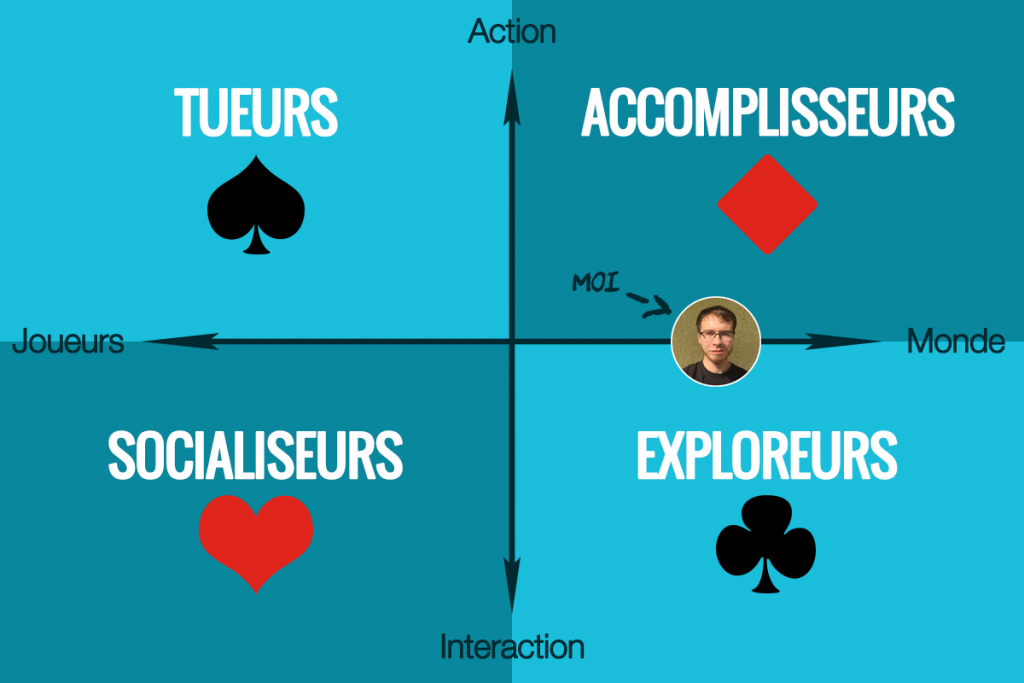
Probably the most famous representation, this taxonomy classifies players into four categories: explorers, achievers, socializers, and killers.
Players then correspond more or less to each of these categories according to their position on two axes: action vs. interaction on the one hand, and world vs. players on the other. Thus, a killer will enjoy acting on other players more, while an explorer will enjoy interacting with the world, for example.
This model is widely used, and a change in the number of players in one category generally has an impact on other categories. For example, if the number of killers in a game increases, it is likely that the number of achievers will decrease accordingly. Understanding these relationships between different categories of players helps to balance the player population in certain games, particularly massively multiplayer online (MMO) games.
Personally, according to the test, I am: Explorer 73%, Achiever 73%, Socializer 27%, Killer 27%. How about you?
If you are interested in this model, there is also an 8-category version with a third axis: implicit vs. explicit. It is also interesting to note that none of us belong to a single category, but rather change roles as we gain experience with the game.
The Big Five model adapted for gamers
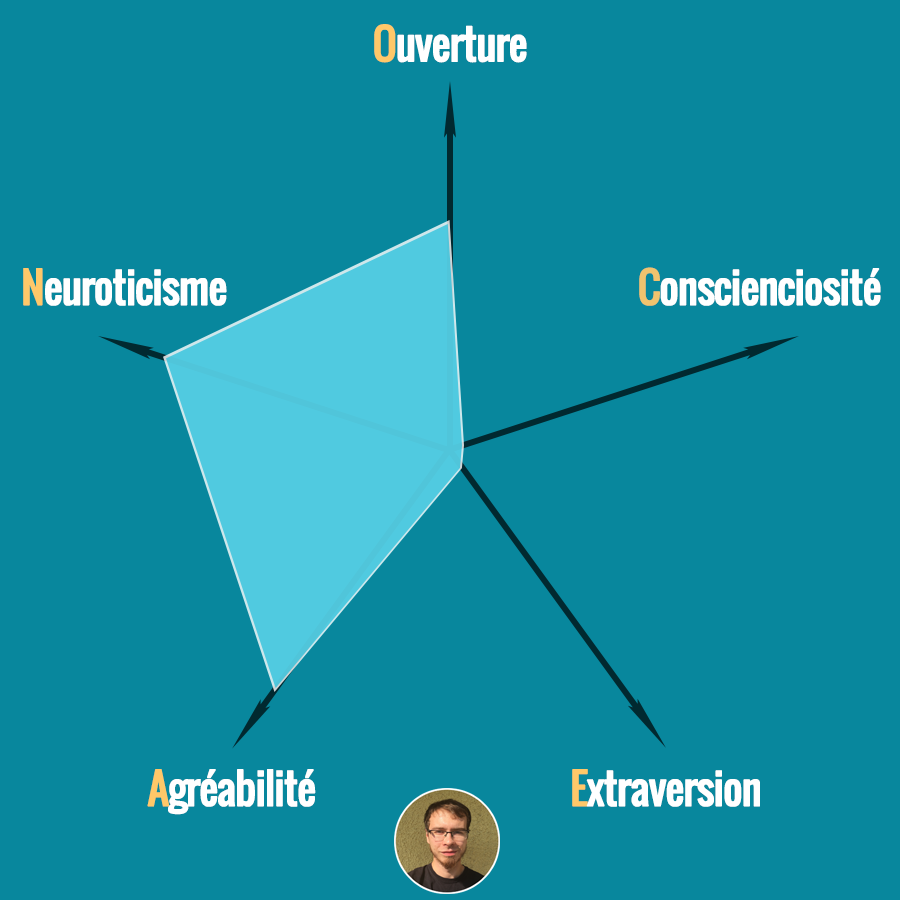
In psychology, a model has been proposed to represent the factors that make up each of our personalities. This is the Big Five model, also known as OCEAN because it contains five components:
- Openness: curiosity and imagination, appreciation of art, emotions, and adventures
- Conscientiousness: organization, self-discipline, fulfillment of obligations
- Extraversion: stimulation and seeking the company of others
- Friendliness: cooperation, compassion, and belief in the goodness of others
- Neuroticism: vulnerability and tendency to be emotionally unstable
So it is not a question of five categories of people, but of five different measures for each of us, all of which make up our personality.
How does this help us in the field of video games? Jason VandenBerghe, a designer at Ubisoft, has adapted this model to determine the gameplay elements that make a game appealing or unappealing to us, depending on our personality traits. He talks about five areas of gameplay, each corresponding to a trait in the Big Five model:
- New feature (corresponding tothe Overture): new, beautiful, or interesting elements
- Challenge ( corresponding to Conscientiousness): elements requiring self-discipline
- Stimulation ( corresponding toExtraversion): elements that are exciting or provoke exciting social interaction
- Harmony ( corresponding toFriendliness): elements that enable you to act positively towards other players
- Threat ( corresponding to Neuroticism): elements that provoke negative emotions in players
This model evolves from year to year, and in his talk at GDC 2013, Jason VandenBerghe suggests leaving out the Threat component and breaking down each of the other components into four subcategories (using two axes, as in Bartle's taxonomy).
This new model gives a total of 256 possible player types.
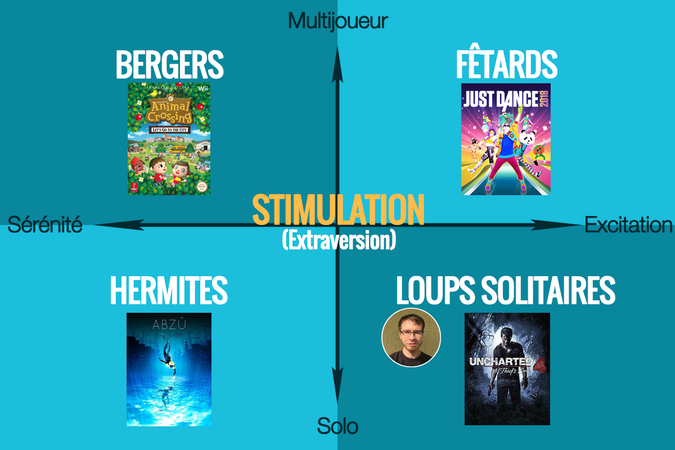
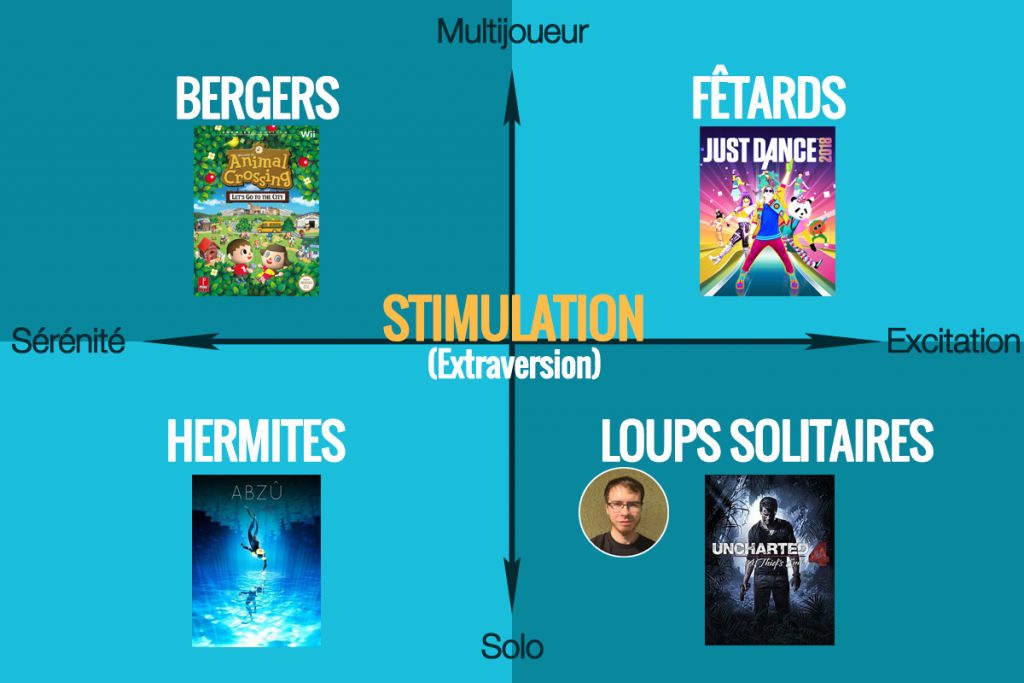
Let's take Stimulation as an example. The two axes proposed are multiplayer vs. solo and excitement vs. serenity. A player with a high score on the multiplayer component and on the excitement component will therefore be more attracted to party games, while a player with a low score on both components will be more inclined towards calm and contemplative games. Similarly, a multiplayer-serenity player will enjoy calm games that offer interaction with other players, while a solo-excitement player will prefer solo action games.
Conclusion
There are many models representing different types of players, and they are constantly being questioned, but some of these models are widely recognized and accepted. I have presented two of them to you. These models help individuals discover who they are, but they are especially useful for video game designers.
Designers use it for two reasons: to target a specific audience and to improve their empathy towards a group of players who do not match their own personality. Because it is our job as designers to dig deep, explore, and understand behaviors and tastes that do not correspond to our own.
And what better way to develop empathy than by playing a role? So I'm going to start a game again, hide in a bush, and wait sneakily for an explorer to pass by so I can rob them, mwahaha!
Resources
The Bartle Test of Gamer Psychology
HEARTS, CLUBS, DIAMONDS, SPADES: PLAYERS WHO SUIT MUDS
Bartle's Taxonomy - What Type of Player Are You? - Extra Credits
Balancing an MMO Ecosystem - Getting a Mix of Player Types - Extra Credits
Player Type Theory: Uses and Abuses | Richard BARTLE
Applying the 5 Domains of Play: Acting Like Players
