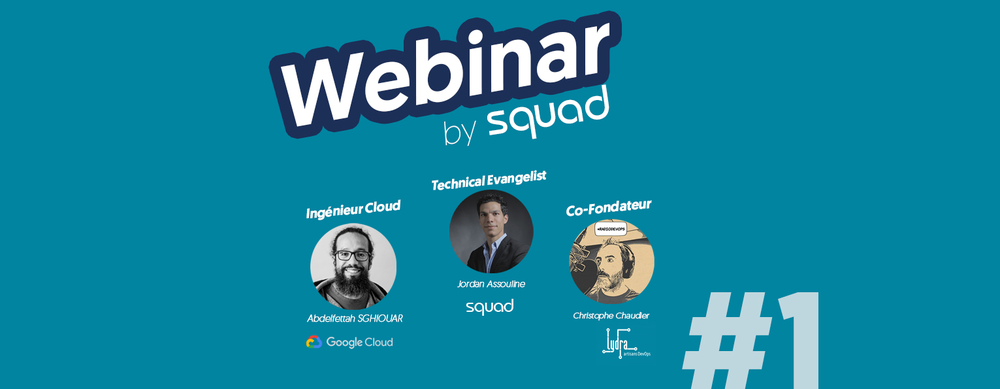
Le 8 octobre dernier, Squad a organisé une table ronde sur le thème du Cloud et du DevOps. Au programme, des échanges autour des tendances, de la sécurité, des données… Nous avons pu comparer trois points différents, celui d’Abdelfettah SGHIOUAR (Ingénieur Google Cloud), Christophe Chaudier (Indépendant et Podcasteur Radio DevOps) et Jordan Assouline (Technical Evangelist Squad).
[#1] La révolution Cloud est là, quelle est la prochaine étape ?
La révolution est là, mais cela va prendre beaucoup de temps pour que tout le monde passe aux bonnes pratiques définies par les fournisseurs de services Cloud. D’ici 10 ou 20 ans, tout le monde fera du CI/CD, du DevOps, du DevSecOps et du SRE.
« Beaucoup utilisent le Cloud, mais pas seulement, ils font de l’hybridation. Ils gèrent des infrastructures, mais passent certains services dans le Cloud, donc ils ne font pas de migration totale. »
Abdelfettah SGHIOUAR.
Certaines sociétés sont toujours en évolution. Le passage au Cloud n’est pas si évident que cela, parce que certaines entreprises ont investi dans les équipements composants un DataCenter et doivent amortir cet investissement. D'autres adaptent les moyens de faire du cloud en On-Premise. En effet, on peut faire du CI/CD et du DevOps avec un serveur physique ou un serveur virtuel.
« Je rencontre encore des sociétés qui ne sont pas du tout dans la virtualisation. Elles passent du Bare-metal vers le Cloud, directement sans passer par la virtualisation ou du Bare-metal vers du conteneur. »
Abdelfettah SGHIOUAR
En résumé, le Cloud a révolutionné la manière de faire les choses, mais pas forcément dans son adoption par tous. « La transition vers le Cloud est lente, car il faut aussi changer la culture et la mentalité des collaborateurs », rappelle Abdel.
« Je remarque aussi chez nos clients que les méthodes dites du cloud sont appliquées sur du « On-Premise ». La transition existe, elle est possible en fonction de la maturité des technologies, mais aussi de la méthodologie. » Jordan Assouline
Christophe, de son côté, remarque qu’une grande partie des sociétés n’ont pas encore choisi le tournant DevOps et le Cloud. Il y a deux types d’entreprise : ceux qui ont encore un data center (ce sont ceux qui se demandent pourquoi ils vont y aller (dans le Cloud) et le pourquoi est important) ; et les pure players. Les entreprises émergentes (ou startup) vont directement dans le Cloud.
« La question qu’il faut se poser : C’est quoi mon business ? Est-ce qu’il faut opérer notre infrastructure et notre business à côté ? Ou notre business, c’est de faire notre métier ? »
Christophe Chaudier
Certaines vieilles entreprises ne se sont pas encore poser la question « C’est quoi mon business ? », alors qu’ils opèrent encore dans leur infrastructure.
Un retour en arrière est-il possible selon vous ?
Christophe souligne l’aspect écologique : Aujourd’hui, la centralisation des DataCenters nous permet de consommer moins de matériels.
« Si chaque entreprise faisait son data center, cela prendrait plus de place et les places sont chères. Je crois plus à une émergence des petits opérateurs de Cloud qu’à une réinternalisation de l’infrastructure d’une société ».
Christophe Chaudier
Les actualités internationales impactent fortement la technologie, notamment la politique. Si un pays décide de fermer ses frontières, il va falloir rapatrier toutes les technologies.
« Au Maroc, par exemple, il y a des contraintes par rapport aux hébergements des données. Les sociétés n’ont pas le droit d’héberger des données en dehors du territoire. Il y a une émergence de petites sociétés d’hébergements Marocaines. »
Abdelfettah SGHIOUAR
Ensuite, il y a des sociétés qui basculent entre Cloud et Prem’Cloud. Les sociétés vont surtout dans le Cloud, car cela leur apporte une valeur ajoutée, il y a beaucoup plus que de la VM, du stockage de données…
Sur les aspects techniques, beaucoup d’entreprises utilisent de la conteneurisation avec Docker (en tête) mais avec l’avènement des micro-services, des orchestrateurs comme Kubernetes, quelles seront les nouvelles technologies qui vont changer le Cloud ?
Aujourd’hui, la grande émergence est le « ServerLess ».
«En tant que développeur, je ne travaille que sur mon conteneur et j’exécute une commande, sans me préoccuper du serveur ou du stockage. Knative, c’est une couche d’abstraction au-dessus de Kubernetes, qui permet de déployer un conteneur et le framework Knative s’occupe de faire le scale-up et le scale-down. » Abdelfettah SGHIOUAR
La tendance c’est le passage du compute (donc des conteneurs) vers du Serverless sur d’autres offres notamment les messages Queues, le CDN (réseau de distribution de contenu) et toutes les dépendances d’une application.
Avant, la tendance était plutôt client-serveur, et aujourd’hui on va plutôt vers un modèle SaaS.
« La tendance, c’est finalement de pouvoir se connecter via un outil. On va de plus en plus sur un modèle "en ligne", avec le Cloud Computing. Le retour à la souris et au clavier connectés à un serveur et tout le temps disponible. Le Edge Computing va être une des révolutions majeures dans les années à venir ».
Christophe Chaudier
Abdel constate également l’émergence du Edge Computing. « J’ai eu des expériences du Edge Computing dans des endroits où il n’y a pas forcément de connexion internet ».

« Ils ont installé leur propre Cluster Kubernetes dans les magasins : il permet de gérer tous les points yourself, les badges des employés, les caméras CCTV, etc. L’idée est donc de ramener le processing là où on en a besoin. » Abdelfettah SGHIOUAR
Plus que de l’IoT, l’entreprise utilise des processeurs X86 Intel Nuc en 3 machines, il bootstrap automatiquement. Cette enseigne était précurseure, puisqu’elle était parmi les premiers à le faire. Avec le Cloud, on peut donc faire des mises à jour, monitorer à distance, appliquer des patchs. Aujourd’hui, plusieurs sociétés proposent ce service.
Qu’en est-il de la sécurité ?
Les entreprises, comme Orange, peuvent se permettre d’avoir leur propre Data Center.
« Pour moi, je pense qu’on va vers plus de prestations. Dans le Cloud et l’informatique, il y a deux choses : le logiciel et le matériel. Ce n’est pas parce que la gestion d’un logiciel est déléguée à un prestataire ou que la sécurité logiciel de nos services ou de nos outils informatiques sont en interne, que le matériel va forcément être sécurisé. Je pense qu’on va assister à la rélocalisation de certaines choses, mais connectées. » Christophe Chaudier
« [..] Il va y avoir des bouts de DataCenters qui seront connectés à un Cloud plus grand et l’opérateur Cloud va opérer tous ces différents éléments qui seront déportés. »
Christophe Chaudier
Dans la seconde partie du webinar, nous avons discuté de la protection des données. Existe-t-il un concensus commun à tous ? Sommes-nous protégés ?
[#2] Sommes-nous maîtres de nos données ?
Le Cloud Act correspond au territoire numérique des Etats-Unis, seule une décision de la justice américaine permettra de donner l’accès aux données. C’est théoriquement faisable. « Pour moi, le problème c’est qu’on accepte que ce soit possible. On se prive de notre souveraineté », Christophe Chaudier. Pour le moment, il n’y a aucune discussion politique sur ce sujet et le Cloud Act fait foi.
« Même si on héberge nos données chez un opérateur avec nos propres clés, à un certain moment où on décrypte ces données, l’opérateur a accès à ces clés. Pendant quelques secondes, ces données sont disponibles dans la mémoire du serveur. Il y a alors une autre problématique : ne doit-on pas chiffrer aussi la mémoire de l’opérateur ? »
Abdelfettah SGHIOUAR
Il y a encore quelques années, le chiffrement était interdit en France. Ici encore, une question doit être posée : qui a la souveraineté pour décrypter des données ?Dans le cas ci-dessous, le FBI avait demandé à Apple de débloquer un iPhone dans le cadre d’une enquête et cette dernière a refusé.Finalement, le FBI a réussi à décrypter l’appareil sans l’aide de la société
Au-delà de la légalité du cryptage, protéger les données est une affaire de tous. Des employés d’une banque sudafricaine ont sorti la clé maître d’une banque, faisant perdre des millions de dollars.
"The HMK is the key that protects all the keys, which, in a mainframe architecture, could access the ATM pins, home banking access codes, customer data, credit cards, etc.," the researcher told ZDNet.
Il ne faut jamais sortir la clé du compte root. C’est évident, et pourtant, beaucoup d’entreprises doivent payer ce type d’erreur banale. La formation ou la sensibilisation est-elle meilleure aujourd’hui ? Doit-on obliger les entreprises à la sensibilisation à la cybersécurité ?
« Il faut se former sur les aspects légaux, et pas seulement techniques ».
Christophe Chaudier
Certaines sociétés restent persuadées qu’elles sont à niveau. Pour Abdel, il faut une stratégie pour pouvoir aider les employés à éviter les erreurs de base. « Les questions que je pose à mes clients tous les jours « est-ce que le PC de ton développeur est crypté ? Est-ce qu’il a un dispositif pour bloquer l’ordinateur après 5 minutes ».
« Le DevSecOps, c’est du DevOps qui est fait correctement. Ce n’est pas quelque chose d’à part entière. La sécurité qui fonctionne le mieux est une sécurité qui accompagne et non pas une sécurité qui sanctionne ».
Jordan Assouline
La sécurité ne doit pas être contre-productive. « Il faut plutôt prendre des bonnes pratiques, plutôt que d’aller tout sécuriser », ajoute Christophe.
Conclusion
La grande tendance de la révolution « Cloud » est l’hybridation. Globalement, les entreprises aiment avoir la main sur leur infra. Le serverless est l’une des technologies émergentes avec le KNative et le Edge Computing (et pas seulement pour le Gaming). Sur ce point, la grande problématique est la dépendance à la technologie : quand bien même nous sommes en On-Premise, nous n’avons aucune garantie qu’Intel ou HP n’augmentent leurs tarifs.
Au niveau de la Gouvernance, malgré le chiffrement et la sensibilisation, cela reste insuffisant pour protéger nos données. La question qu’il faut se poser : qu’arrivera-t-il si les Etats voudront avoir accès aux données ? Faut-il mettre fin au chiffrement ?
