Par Romain F.
On en entend souvent parler dans la presse, malheureusement accompagné de nombreuses idées reçues, clichés et confusions.
Je voulais aujourd’hui vous parler des darkwebs. Oui, si on veut désigner ce qui regroupe les sites pas toujours si obscurs de l’internet mondial, on dira « les darkwebs ». On commence à peine l’introduction que l’on vient déjà de démolir une première erreur. Ça ne chôme pas par ici.
Le contenu de cet article repose à la fois sur ma propre expérience (je m’intéresse aux darkwebs depuis environ 5 ans) et sur La face cachée d’internet de Rayna Stamboliyska. Livre dont je vous recommande chaudement la lecture si vous voulez creuser le sujet. C’est accessible à tous, même sans connaissance technique.
Je partagerai ici avec vous tout ce que je connais sur le sujet.
Deepweb ≠ Darkweb
Commençons par démolir une idée reçue bien implantée. Il y a souvent une confusion entre les termes deepweb et darkweb.
Le deepweb désigne les pages web qui ne sont pas référencées dans un moteur de recherche comme Google, Qwant ou DuckDuckGo.
Les darkwebs font effectivement partie du deepweb (c’est le but) mais ce n’est pas que ça. Si vous recherchez sur internet « compte en banque de Romain Forgnone » vous ne trouverez rien et fort heureusement. Cette page internet existe mais n’est pas référencée.
Votre fil d’actualité sur les réseaux sociaux fait donc partie du deepweb. Au même titre que votre espace personnel sur impot.gouv ou les articles réservés aux abonnés sur les sites d’infos
En bref, tout ce qui nécessite un nom d’utilisateur et un mot de passe pour y avoir accès ou qui n’est tout simplement pas référencé dans un moteur de recherche fait partie du deepweb. Vous y allez tous les jours.
C’est quoi, un darkweb ?
On a tous déjà vu cette célèbre infographie, représentant internet sous la forme d’un iceberg. Le deep web et « le darknet » en seraient la partie immergée.
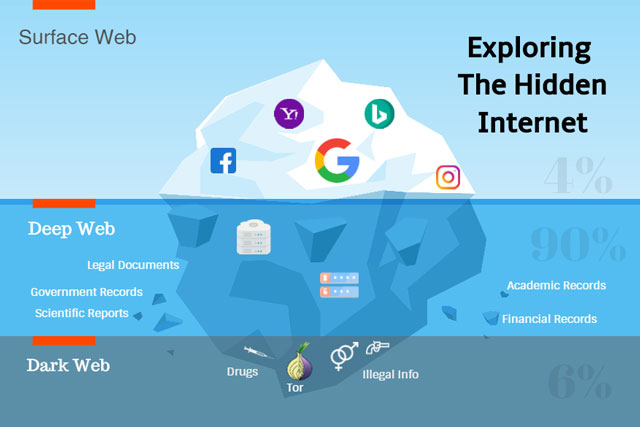
En réalité, cette représentation est bidon mais a été relayée très sérieusement par de nombreux médias surtout à partir de 2016. À cette époque, Valeurs Actuelles et le député Bernard Debré avaient révélé que sur “le darknet”, on pouvait acheter de la drogue « très facilement » (le reportage de Valeurs Actuelles et le discours de Bernard Debré à l’Assemblée).
Alors on laisse l’iceberg où il est et on reprend :
Un darkweb regroupe des sites internet auxquels on peut accéder via un darknet.
Un darknet est un réseau informatique superposé à internet (ou réseau overlay) accessible via des outils informatiques dédiés. Autre exemple de réseau superposé : la voix sur IP, ou VoIP (Skype, par exemple).
Retenez que « web » renvoie au contenu et « net » au réseau donnant accès à ce contenu. Internet permet entre autres, d’accéder à des sites web. Mais aussi d’envoyer et recevoir des e-mails ou de transférer des fichiers.
Un darkweb est généralement accessible via un navigateur dédié. Mais avec les connaissances nécessaires, vous pouvez tout à fait bricoler un navigateur existant comme Mozilla Firefox, pour y accéder.
Personne ne sait exactement combien il en existe. Certains d’entre eux sont accessibles uniquement via un parrainage.
Lorsque la presse et les youtubeurs en parlent, ils parlent en réalité de deux d’entre eux. On les nomme Freenet et Onionland.
Il faut garder à l’esprit que l’objectif de Freenet et de TOR (The Onion Router, le réseau permettant d’accéder à Onionland) est d’offrir aux internautes une navigation internet anonyme et libre. Loin de toute forme de surveillance ou blocage. On peut tout à fait aller sur Google avec le navigateur TOR.
En 1996 le créateur de Freenet, Mike Godwin, disait
« Je suis tout le temps soucieux au sujet de mon enfant et d'Internet, bien qu'elle soit encore trop jeune pour se connecter. Voilà ce qui m'inquiète. Je redoute que dans 10 ou 15 ans elle vienne me voir et me demande : “Papa, où étais-tu quand ils ont supprimé la liberté de la presse sur Internet ?” »
Pour beaucoup, c’est une manière de revenir à l’internet des années 90.
“TOR a changé ma vie, et m’a ramené à l’internet de mon enfance en me donnant la liberté de ne pas être épié” Edward Snowden, Permanent Record (2019).
On y trouve quoi ?
N’ayant jamais été parrainé sur un darkweb, hormis le réseau social « Talkspirit » de Squad (repaire des pires gredins du web) je vous parlerai ici du contenu de Onionland et Freenet.
Des Forums
Les forums de discussion sont généralement les premiers sites que l’on visite. En l’absence de véritable moteur de recherche, difficile de trouver du contenu (il existe quelques moteurs de recherche mais pour la plupart, l’indexation est mise à jour tous les 36 du mois). Ces forums sont un lieu d’échange de liens primordial, notamment pour identifier les sites fiables et les arnaques (il y en a beaucoup).
Certains forums nécessitent un parrainage ou bien de répondre à un questionnaire de culture générale ou de connaissances informatique. Du résultat de ces tests dépendra la validation de votre inscription.
Sur ces forums, tous les sujets peuvent être abordés :
- Tutoriels de piratage informatique
- Débats politiques et religieux
- On y échange des livres numériques
- Différentes méthodes d’arnaques
- Des identifiants Netflix, Spotify, etc …
- Du trolling, beaucoup de trolling
En dehors de ces forums, on trouve des blogs d’artistes de tous genres et des sites humoristiques avec des concepts atypiques.
L’idée générale est de jouir d’une liberté totale, sans aucune restriction.
Des pièges
Je vous parlais d’arnaques, un peu plus haut. Elles sont nombreuses et à l’origine de la plupart des légendes urbaines qui circulent.
Ce sont généralement des petits sites (une à trois pages sont disponibles) décorés avec des images de films d’horreur ou d’espionnage, en fonction de ce qu’on cherche à vous vendre. Car il s’agit bien de ça, vendre un produit. Qu’il s’agisse de snuff movie (film amateur montrant le décès violent d’une personne) ou des services de tueurs à gages. Ces sites sont en réalité des “pièges à touriste”. On se sert de la mauvaise image des darkwebs et de la candeur de la cible pour extorquer de l’argent. L’histoire du site BesaMafia est édifiante sur ce sujet.
À lire : https://www.vice.com/fr/article/9aqmpa/besa-mafia-letrange-site-de-tueurs-a-gages-du-dark-web
Des marchés illégaux
Parlons des fameux darkweb markets maintenant. Je sais que vous l’attendiez impatiemment. Oui ils existent bel et bien. Oui on peut y trouver toutes les drogues possibles et imaginables contre des cryptomonnaies (Bitcoin, Ethereum ou Litecoin mais certainement pas par paiement bancaire). On les trouve assez facilement via les différents forums dont je parlais plus haut. Feu le site internet deepdotweb.com en recensait quelques-uns.
Il y a cependant quelques règles à respecter et vous serez rapidement banni au moindre manquement à ces dites règles. Si vous ne savez pas chiffrer vos e-mails par exemple, personne ne traitera avec vous. Je vous montre pour l’exemple, le règlement d’un darkweb market francophone (fautes comprises).
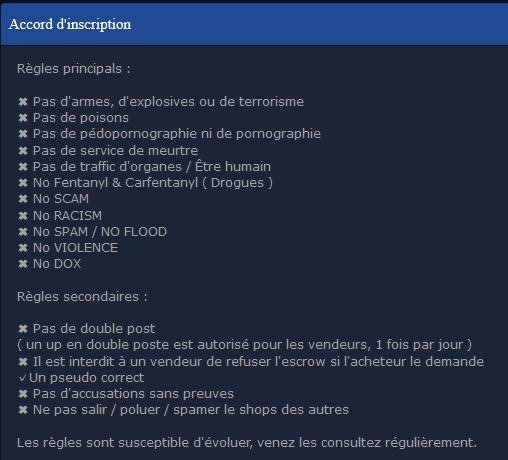
Certains markets sont généralistes et d’autres spécialisés dans un produit particulier.
On peut aussi y trouver :
- Des médicaments nécessitant normalement une ordonnance
- Des faux papiers
- Des logiciels malveillants « prêt à servir ».
Comme d’habitude, il y des arnaques. Au mois d'août 2019 est apparu Camazon (oui …) qui a été survendu sur plusieurs forums comme étant LA nouvelle référence des darkweb markets francophones. Le verdict est tombé moins d’un mois plus tard : c’était une vaste arnaque et le site n’est plus disponible depuis.
Pour ce qui est des armes, on peut effectivement en trouver. En petite quantité et vendues à l’unité. Jusqu’à présent, je n’ai pas vu plus que des armes de poing. Il arrive souvent que des markets refusent la vente d’armes sur leurs plateformes (voir screenshot plus haut). M’étant toujours placé dans un rôle d’observateur curieux, je n’ai jamais franchi l’étape de la transaction sur un market. Aussi il se peut que les annonces de vente dont j’ai été témoin soient des scams (arnaques).
Je faisais régulièrement un tour sur le market de FrenchDeep Web fermé en 2019, la condamnation des fondateurs fait office de preuve que les produits vendus sur ce marché étaient authentiques.
Je vous invite à vous renseigner sur l’histoire de SilkRoad, le plus gros market jamais créé. Indisponible depuis que son créateur, Ross Ulbricht, est en prison. Un récit passionnant. D’autant plus que mis à part la nature des produits vendus, SilkRoad avait tous les aspects d’une plateforme de vente en ligne classique comme Amazon.
En tant que darkwebs, Onionland et Freenet obéissent à la règle implicite de n’importe quel web : on y trouve ce que l’on recherche. N’ayant pas recherché de pédopornographie pour des raisons évidentes, je ne peux pas vous confirmer qu’il en existe bel et bien sur ces réseaux.
Cependant, les affaires judiciaires sur ce sujet prouvent que ces sites sont une triste réalité.
Il y aurait encore beaucoup à dire sur le sujet, mais nous ne sommes pas là pour écrire un livre. En plus, ça a déjà été fait. Si l’idée à l’origine de Freenet et TOR est louable, elle sert aussi des desseins illégaux. D’un autre côté, cette tendance s’inscrit dans une philosophie de liberté quasi-totale propre à ses utilisateurs.
Retenez malgré tout que :
- Non on ne peut pas assister à un meurtre en direct
- Non on ne peut pas engager un tueur à gage
- Les cryptomonnaies ont plein d’autres utilités que d’acheter de la drogue sur un darkweb market
- Non il n’y a pas de documents classifiés de la CIA (à ma connaissance, les seuls qu’on peut trouver sont sur Wikileaks), idem pour tous les fantasmes complotistes que vous avez peut-être entendu.
En dehors des markets et des arnaques, on trouve des gens passionnés et passionnant qui souhaitent partager et apprendre avec d’autres. C’est aussi un support de totale liberté d’expression.
Ça reste un sujet peu connu du grand public et qui souffre d’un traitement médiatique bourré de clichés.
Je ne vous recommande pas de vous documenter sur Youtube et ces nombreux « Top 10 des PIRES sites du darquenette ». Même si certains ont fourni un vrai travail d’enquête de fond, on peut encore relever quelques erreurs et confusions.
Le mieux reste encore de vous faire votre propre avis si vous le souhaitez. En revanche, sortez couverts, prenez un VPN, même si l’utilité de cette protection sur ces réseaux est sujette à débats depuis quelques temps.
