
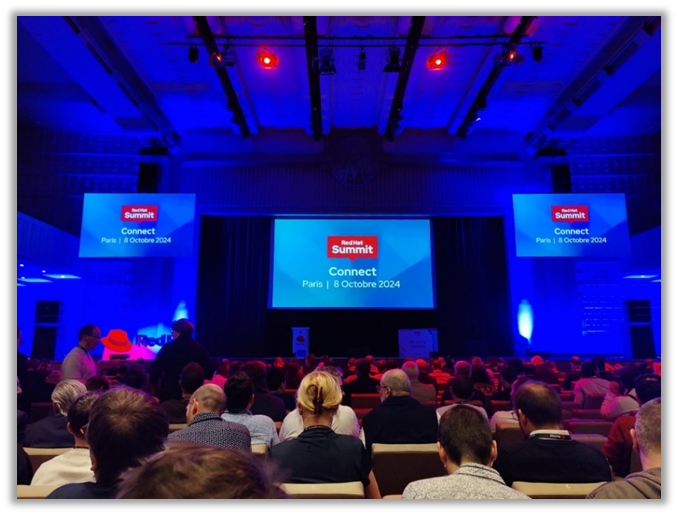
On October 8, 2024, the Maison de la Mutualité in Paris hosted Red Hat Summit Connect Paris 2024, a leading event for technology industry specialists. With inspiring keynotes, in-depth case studies, and strategic discussions, this event highlighted the challenges facing businesses while offering insights into innovative solutions focused on open source, artificial intelligence (AI), and automation. Here's a look back at a day rich in complex and revealing lessons.
"Open source is the key to bringing order to chaos and creating tailored, scalable AI solutions." - David Szegedi
Virtualization and Automation: Orange, EDF, and OpenShift
Orange and EDF have both undertaken ambitious projects focused on virtualization and automation to modernize their infrastructures and optimize their operations.
Orange: Modernization of SDN POPs with OpenShift
Mame Bess Ndoye Diop, Telco Cloud Design Director at Orange, presented details of the SDN POP modernization.
Orange has undertaken a modernization project using OpenShift Virtualization, aimed at unifying the management of containerized and virtualized workloads. Their SDN POP v2 infrastructure allows VNF and CNF to be combined, offering a more secure architecture capable of supporting critical services such as SDWAN and Mobile Core. The project aims to deploy 50 POPs by 2024 and 75 by 2026, thereby reducing costs and improving network flexibility.
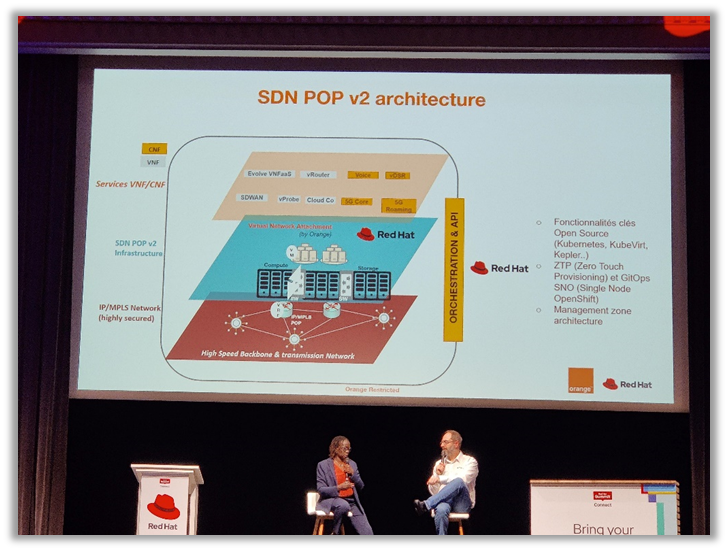
This new SDN POP V2 architecture offers advantages such as cost reduction and support for services regulated by ANSSI.
EDF: Automation with Ansible and Streamlining of IT Tools
Dominique Massoni, Director of the IT Development, Automation, and Tooling Program, and Florian Delacroix, IT Consultant at EDF, presented EDF's automation strategy.
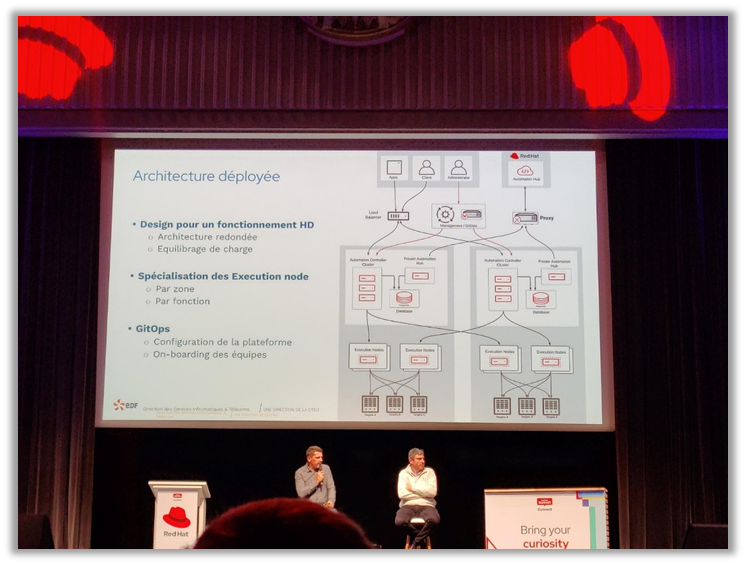
EDF, for its part, has opted to automate its systems with Red Hat Ansible Automation Platform (AAP), integrating around 20,000 computing instances, mainly on on-premises infrastructure. Their strategy of consolidating internal skills and optimizing processes has resulted in 100% availability and more than 90,000 automated triggers. However, integrating different IT outsourcing processes remains a challenge to be addressed in order to further improve operational efficiency.
EDF also shared its initiative to internalize the management of monitoring tools with Dynatrace and Zabbix, while leveraging AAP to streamline its IT processes. Their approach has enabled them to achieve 100% availability while reducing the error rate of automated processes.
OpenShift Virtualization: Towards a Unified Infrastructure
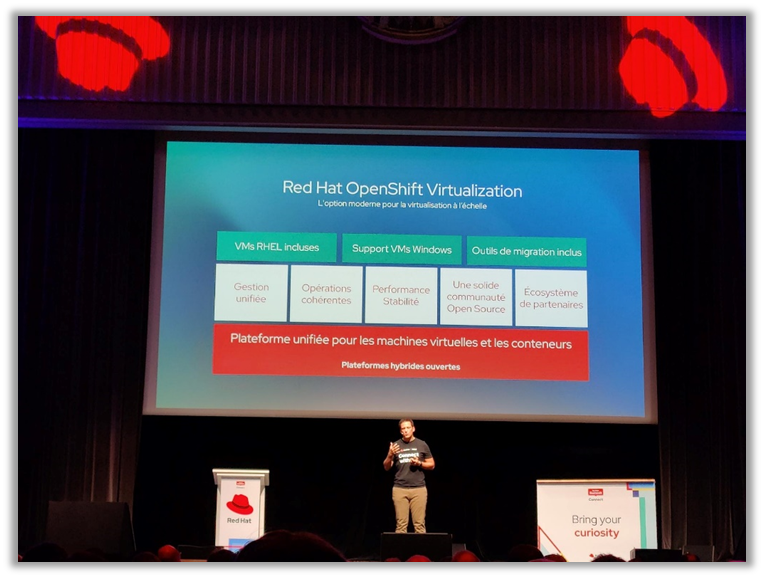
Virtualization was a major topic at Red Hat Summit Connect, particularly in terms of reducing the costs associated with legacy infrastructures. Red Hat presented Red Hat OpenShift Virtualization, a solution that aims to extend KVM technology to Kubernetes, offering a unified infrastructure that combines hybrid cloud flexibility with optimized virtual machine management.
The Red Hat Migration Toolkit (MTV) facilitates the migration of virtual machines to OpenShift, enabling organizations to create a modern, adaptable infrastructure capable of handling workloads both on-premises and in the cloud.
Generative AI and Open Source: An Unmissable Alliance
David Szegedi, Chief Technology Officer, emphasized that open source is crucial for structuring the AI landscape.
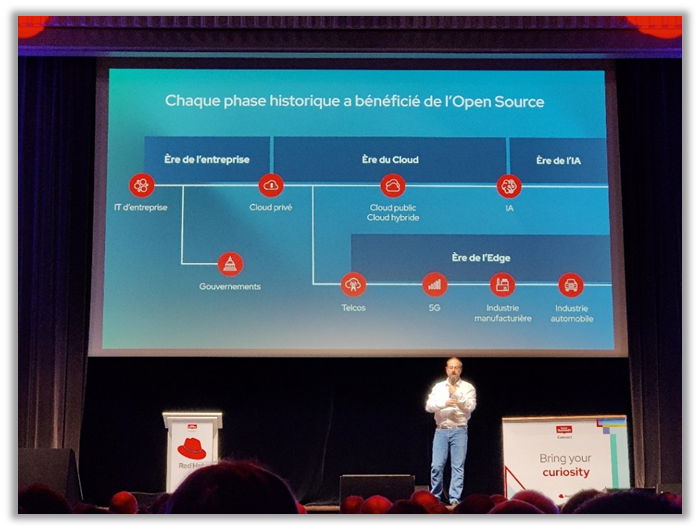
Generative AI is profoundly transforming the way companies innovate and automate their processes. However, it is alarming to note that 86% of data science projects never reach production (source: IDC Market Analysis Perspective 2023). This high failure rate reveals a need for more flexible and collaborative approaches, reinforcing the need for open source in the field of AI.
Red Hat solutions, such as Red Hat Enterprise Linux AI, Red Hat OpenShift AI, and Red Hat Lightspeed, enable the combination of AI and hybrid cloud while using open source models such as IBM® Granite™, capable of meeting specific business needs.
These solutions include techniques such as fine-tuning and RAG (Retrieval-Augmented Generation), which enable AI models to be adapted to business needs. The flexibility of open source is therefore a major strategic asset for companies wishing to exploit AI in an optimized and scalable way.
"Don't rush headlong into AI" — AI is costly in terms of both human and material resources. Careful, optimized integration is crucial to maximizing added value.
AI and Modernization: Dassault Aviation and Airbus Helicopters
Dassault Aviation: OpenShift and AI as a Cognitive Assistant
Laurent Bendavid, Chief Information Officer at Dassault Aviation, andStéphane Ardouin, Platform Technical Architect Team Lead, shared their experience using OpenShift and AI as a cognitive assistant.
In its quest for modernization, Dassault Aviation migrated from VMware Tanzu to Red Hat OpenShift in order to leverage container technologies. Their AI adoption strategy focuses on cognitive assistance, particularly to reduce the workload of pilots in military contexts. The project includes the use of clusters for MLOps, as well as a secure infrastructure aligned with SecNumCloud standards to handle critical use cases.
"AI is an assistant, not a replacement. It must integrate seamlessly to enhance human capabilities." - Laurent Bendavid, Dassault Aviation
Intel and Red Hat: Collaboration for Large-Scale AI
Intel is collaborating with Red Hat to integrate large-scale AI technologies using Intel® Gaudi® 3 accelerators and Edge solutions. These technologies are designed to maximize the performance and productivity of AI systems, while using Confidential Computing technologies to ensure the security of sensitive data. This enables businesses to adopt resilient infrastructures that are adapted to the growing needs of AI.
Security and Observability: F5 and Dynatrace
Secure Application Delivery with F5 and NGINX
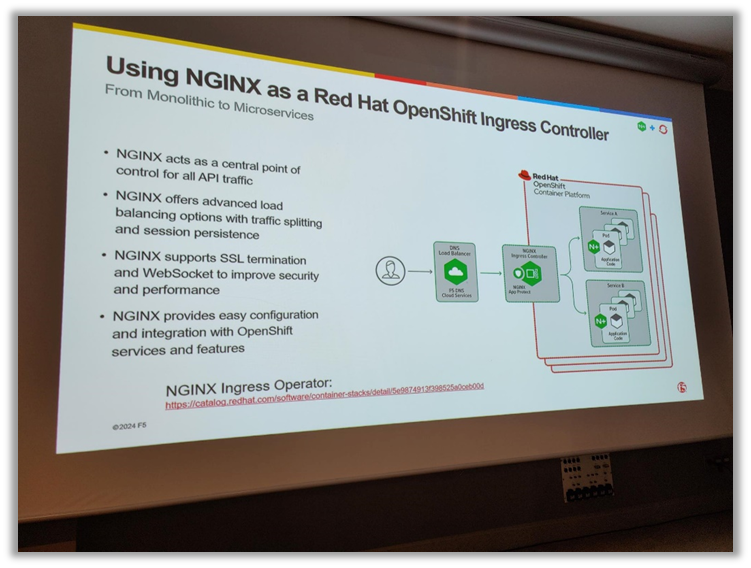
Thomas Genet, Solutions Engineer at F5, highlighted the importance of NGINX as an ingress controller for OpenShift. With its robust architecture, NGINX offers essential features such as traffic splitting, conditional routing, and WAF protection, which are crucial for ensuring secure application delivery in high-demand environments.
Observability and Automation with Dynatrace
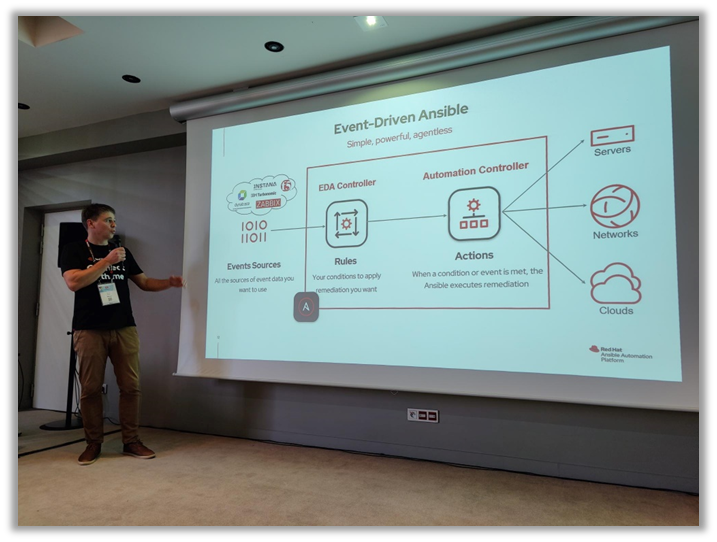
Observability and event-driven automation were the focus of the session on Event-Driven Ansible with Dynatrace. The demonstration showcased the ability to automatically detect and remediate incidents through the integration of Dynatrace, Ansible, and ServiceNow. This approach helps improve system resilience, reducing downtime and ensuring optimal service continuity.
Towards Ethical and Sustainable Technology?
These feedback sessions, presentations, and discussions illustrated the importance of open source in business transformation, whether it be leveraging AI, migrating to hybrid infrastructures, or strengthening process automation. For businesses, the path to AI, hybrid cloud, and automation is fraught with challenges—but also immense opportunities to be seized.
Faced with rapid innovations and technological advances that are redefining our businesses, one question remains essential:
"Can technology evolve to serve humanity without sacrificing our core values?"
To answer this question, it is essential to rethink the role of innovation: it must go beyond the simple quest for efficiency and aim for real and sustainable improvement in the human condition. By integrating ethical values into the design of technologies, we can hope for a future where technological progress and human well-being go hand in hand.

